graphic design
noun
The art or skill of combining text and pictures in advertisements, magazines, or books.
Graphic design
Graphic design is the process of visual communication and problem-solving using one or more of typography, photography and illustration. The field is considered a subset of visual communication and communication design, but sometimes the term "graphic design" is used synonymously.
Graphic designers create and combine symbols, images and text to form visual representations of ideas and messages. They use typography, visual arts and page layout techniques to create visual compositions. Common uses of graphic design include corporate design (logos and branding), editorial design (magazines, newspapers and books), wayfinding or environmental design, advertising, web design, communication design, product packaging and signage.
Applications
Color
Graphic design is applied to everything visual, from road signs to technical schematics, from interoffice memorandums to reference manuals.
Design can aid in selling a product or idea. It is applied to products and elements of company identity such as logos, colors, packaging and text as part of branding (see also advertising). Branding has increasingly become important in the range of services offered by graphic designers. Graphic designers often form part of a branding team.
Textbooks are designed to present subjects such as geography, science and math. These publications have layouts that illustrate theories and diagrams. Graphic design also applied to layout, formatting, illustrations and charts.
Graphic design is applied in the entertainment industry in decoration, scenery and visual story telling. Other examples of design for entertainment purposes include novels, vinyl album covers, comic books, DVD covers, opening credits and closing credits in filmmaking, and programs and props on stage. This could also include artwork used for T-shirts and other items screenprinted for sale.
From scientific journals to news reporting, the presentation of opinion and facts is often improved with graphics and thoughtful compositions of visual information - known as information design. Newspapers, magazines, blogs, television and film documentaries may use graphic design. With the advent of the web, information designers with experience in interactive tools are increasingly used to illustrate the background to news stories.
Skills
A graphic design project may involve the stylization and presentation of existing text and either preexisting imagery or images developed by the graphic designer. Elements can be incorporated in both traditional and digital form, which involves the use of visual arts, typography, and page layout techniques. Graphic designers organize pages and optionally add graphic elements. Graphic designers can commission photographers or illustrators to create original pieces. Designers use digital tools, often referred to as interactive design, or multimedia design. Designers need communication skills to convince an audience and sell their designs.
The "process school" is concerned with communication; it highlights the channels and media through which messages are transmitted and by which senders and receivers encode and decode these message. The semiotic school treats a message as a construction of signs which through interaction with receivers, produces meaning; communication as an agent.
Typography
Typography includes type design, modifying type glyphs and arranging type. Type glyphs (characters) are created and modified using illustration techniques. Type arrangement is the selection of typefaces, point size, tracking (the space between all characters used), kerning (the space between two specific characters) and leading (line spacing).
Typography is performed by typesetters, compositors, typographers, graphic artists, art directors and clerical workers. Until the digital age, typography was a specialized occupation.
Page layout
Page layout deals with the arrangement of elements (content) on a page, such as image placement, text layout and style. Page design has always been a consideration in printed material and more recently extended to displays such as web pages. Elements typically consist of type (text), images (pictures), and (with print media) occasionally place-holder graphics for elements that are not printed with ink such as die/laser cutting, foil stamping or blind embossing.
Printmaking
Printmaking is the process of making artworks by printing on paper and other materials or surfaces. The process is capable of producing multiples of the same work, each called a print. Each print is an original, technically known as an impression. Prints are created from a single original surface, technically a matrix. Common types of matrices include: plates of metal, usually copper or zinc for engraving or etching; stone, used for lithography; blocks of wood for woodcuts, linoleum for linocuts and fabric plates for screen-printing. Works printed from a single plate create an edition, in modern times usually each signed and numbered to form a limited edition. Prints may be published in book form, as artist's books. A single print could be the product of one or multiple techniques.
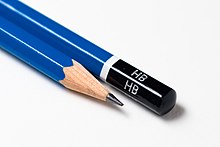
The pencil is one of the most basic graphic design tools.
Aside from technology, graphic design requires judgment and creativity. Critical, observational, quantitative and analytic thinking are required for design layouts and rendering. If the executor is merely following a solution (e.g. sketch, script or instructions) provided by another designer (such as an art director), then the executor is not usually considered the designer.
Tools
The method of presentation (e.g. Arrangements, style, medium) is important to the design. The development and presentation tools can change how an audience perceives a project. The image or layout is produced using traditional media and guides, or digital image editing tools on computers. Tools in computer graphics often take on traditional names such as "scissors" or "pen". Some graphic design tools such as a grid are used in both traditional and digital form.
In the mid-1980s desktop publishing and graphic art software applications introduced computer image manipulation and creation capabilities that had previously been manually executed. Computers enabled designers to instantly see the effects of layout or typographic changes, and to simulate the effects of traditional media. Traditional tools such as pencils can be useful even when computers are used for finalization; a designer or art director may sketch numerous concepts as part of the creative process. Styluses can be used with tablet computers to capture hand drawings digitally.
Computers
Some designers dispute that computers enhance the creative process. Computers allow designers to explore multiple ideas quickly and in more detail than can be achieved by hand-rendering or paste-up.[18] However, some designers find the limitless choices from digital design lead to paralysis or to endless iterations with no clear outcome.
Hand-rendered layouts can be used to get approval for an idea execution before a designer invests time to produce finished visuals. Then the idea is finished on the computer in a hybrid process.
Nearly all of the popular and "industry standard" software programs used for graphic design since the early 1990s are products of Adobe Systems Incorporated. Adobe Photoshop (a raster-based program for photo editing) and Adobe Illustrator (a vector-based program for drawing) are often used in the final stage. Designers often use pre-designed raster images and vector graphics in their work from online design databases. Raster images may be edited in Adobe Photoshop, logos and illustrations in Adobe Illustrator, and the final product assembled in one of the major page layout programs, including Adobe InDesign. Graphic designers are expected to be proficient in these programs.
Interface design
Since the advent of personal computers, many graphic designers have become involved in interface design, in an environment commonly referred to as a Graphical User Interface (GUI). This has included web design and software design, when end user interactivity is a design consideration of the layout or interface. Combining visual communication skills with an understanding of user interaction and online branding, graphic designers often work with software developers and web developers to create the look and feel of a web site or software application. An important aspect of interface design is icon design.
User experience design
User experience design considers how a user interacts with and responds to an interface, service or product.
Experiential graphic design
Experiential graphic design is the application of communication skills to the built environment. This area of graphic design requires practitioners to understand physical installations that have to be manufactured and withstand the same environmental conditions as buildings. As such, it is a cross-disciplinary collaborative process involving designers, fabricators, city planners, architects, manufacturers and construction teams.
Experiential graphic designers try to solve problems that people encounter while interacting with buildings and space. Examples of practice areas for environmental graphic designers are wayfinding, placemaking, branded environments, exhibitions and museum displays, public installations and digital environments.
Occupations
Graphic design career paths cover all parts of the creative spectrum and often overlap. Workers perform specialized tasks, such as design services, publishing, advertising and public relations. As of 2016 median pay was $53,316 per year. The main job titles within the industry are often country specific. They can include graphic designer, art director, creative director, animator and entry level production artist. Depending on the industry served, the responsibilities may have different titles such as "DTP Associate" or "Graphic Artist". The responsibilities may involve specialized skills such as illustration, photography, animation or interactive design.
Employment in design of online projects was expected to increase by 35%, while traditional designs, such as publications, faced slower rates of 16% or less.
Graphic designers can work within companies devoted specifically to the industry, such as design consultancies or branding agencies, others may work within publishing, marketing or other communications companies. Especially since the introduction of personal computers, many graphic designers work as in-house designers in non-design oriented organizations. Graphic designers may also work freelance, working on their own terms, prices, ideas, etc.
A graphic designer typically reports to the art director, creative director or senior media creative. As a designer becomes more senior, they spend less time designing and more time leading and directing other designers on broader creative activities, such as brand development and corporate identity development. They are often expected to interact more directly with clients, for example taking and interpreting briefs.
Crowdsourcing in graphic design
Jeff Howe of Wired Magazine first used the term "crowdsourcing" in his 2006 article, "The Rise of Crowdsourcing." It spans such creative domains as graphic design, architecture, apparel design, writing, illustration etc. Tasks may be assigned to individuals or a group and may be categorized as convergent or divergent. An example of a divergent task is generating alternative designs for a poster. An example of a convergent task is selecting one poster design.
I like the practical information you provide. Go to see this buy essay in 3 hours page. I'm quite sure I will learn plenty of new stuff right here!
ReplyDelete